In March 1994, in a small movie theater in Hamburg, Germany, an Orthodox Jewish man gave up his seat to watch Schindler’s List on his feet. My girlfriend had taken the seat next to his, and we were all packed in shoulder to shoulder. His faith didn’t allow him to touch a woman who wasn’t his wife or family. So he got up and stood at the back for more than three hours. I’ve thought about him for thirty years.
I came to this as a filmmaker, out of love for film and respect for what the Jewish people endured. That afternoon showed me a movie could carry more weight than I ever thought possible. Years later, I got to learn how that movie was made, from the man whose hand was on the lens.
The film had just opened in Germany. I went to a midday showing in English at the Abaton, a small arthouse cinema in Hamburg’s Grindel quarter. The room I was in held only about 60 classic red seats. Before the war, the Grindel was the heart of Jewish life in the city. Its main synagogue stood a short walk away until it was wrecked on Kristallnacht and torn down.
The room was nearly full. Many of the people there seemed to be Orthodox Jewish men. Others, like us, weren’t Jewish, and there were only a few women, my Sicilian girlfriend among them. It was nothing like the big theaters I was used to in the States. It was tight and compact. The only two seats left were together, and one of them put my girlfriend right beside one of those men. We were pressed together at the shoulders and hips. In Orthodox Judaism, a man doesn’t touch a woman who isn’t his wife or a close relative. The practice is called shomer negiah. He didn’t say a word or make a scene. He quietly got up and went to stand at the back.
So there he stood, in Germany, fifty years after the war, watching the story of his own people being murdered. He stayed on his feet the whole time.
By the end, all of us were in tears, men and women alike. Strangers sat pressed together in the dark, crying. When the lights came up, my girlfriend’s mascara had run down her face. That’s what Steven Spielberg, a master filmmaker, could do with a camera. He made a room full of strangers in Germany feel what had happened there. I walked back to the U-Bahn at Hallerstraße thinking about where it all began, and about how much this country has done since to face it.
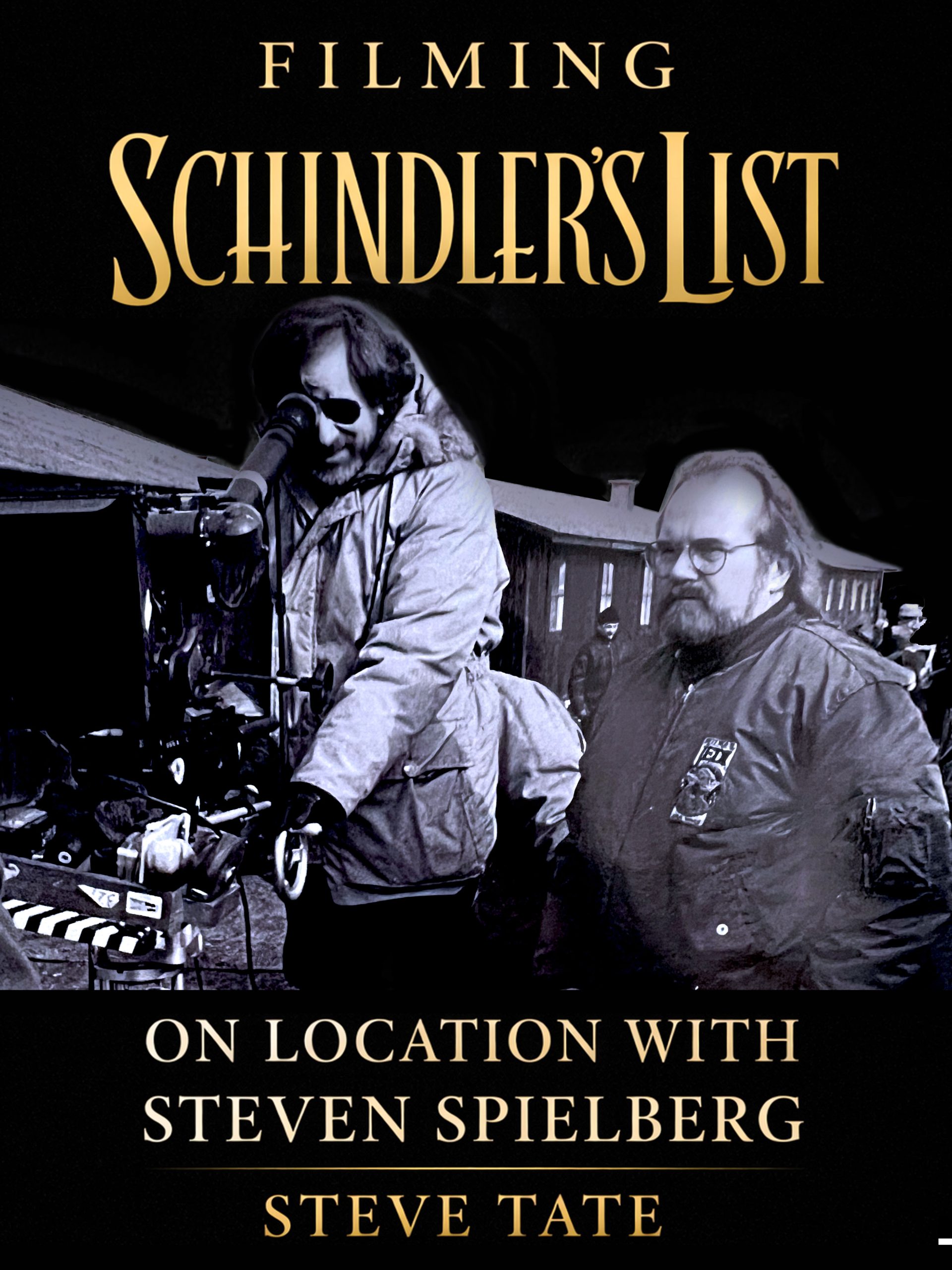
Steve Tate was first assistant camera on Schindler’s List. He was the focus puller, working right beside Steven Spielberg in Poland in 1993. Every shot had to be sharp, and back then there was no monitor clear enough to tell you if it was. You found out the next day at dailies.
Steve passed away before he could tell his story himself. Jason Tate and I had talked about the book a few years earlier, while Steve was still with us, but the timing wasn’t right for him and I was buried in work. After his father died, Jason brought Steve’s notes to me. When I read them, I was back in that theater in Hamburg.
As a filmmaker, I had to know how a film like this gets made. How do you shoot a black-and-white period film in a Polish winter? How do you rebuild a camp in a quarry, run a real train into the scene, and direct hundreds of extras who must never look at the lens? And how do you keep a heavy 35mm film camera in focus when much of the movie is handheld, shot like a newsreel?
So I went deep. I researched the history, the locations and the gear. I studied how a crew keeps working in snow and mud while recreating some of the darkest days in human history, and doing it with care.
Steve’s notes answered a lot of it. He wrote about long, cold days, a camera team he called the best ever, and moments when the whole set went silent because everyone knew what they were filming. He also wrote about his first Sunday off. He went to Auschwitz-Birkenau alone, stood on the selection ramp in the snow, took off his hat, and said Kaddish, the Jewish prayer for the dead. There was no crew and no camera, only Steve.
I’ve worked on films from every angle, writing, producing, directing, shooting to editing. I know what it means to be responsible for focus. On this film, that responsibility was Steve’s, and I wanted readers to see the story through his eyes.
My job was to protect his voice. I shaped his notes into chapters, and where they were brief I added history and background, his behind-the-scenes photos and my own illustrations. It’s still his story, told the way he lived it.
At the end of every chapter, I wrote a Film Tech Note that breaks down the craft behind what Steve describes. You’ll learn how a focus puller handles a 300mm lens, why extras can’t look into the camera, and how one film’s world gets built from many different locations. He lived those details every day, and I wanted you to understand them too.
If you haven’t seen Schindler’s List in a while, watch it again after you finish this book. You’ll see things you never noticed before.
Jason, thank you for making sure your father’s story wouldn’t be forgotten.
— Ron Cobert, Co-Author